How Other Types of Medical Writing Strengthen Your CME Career
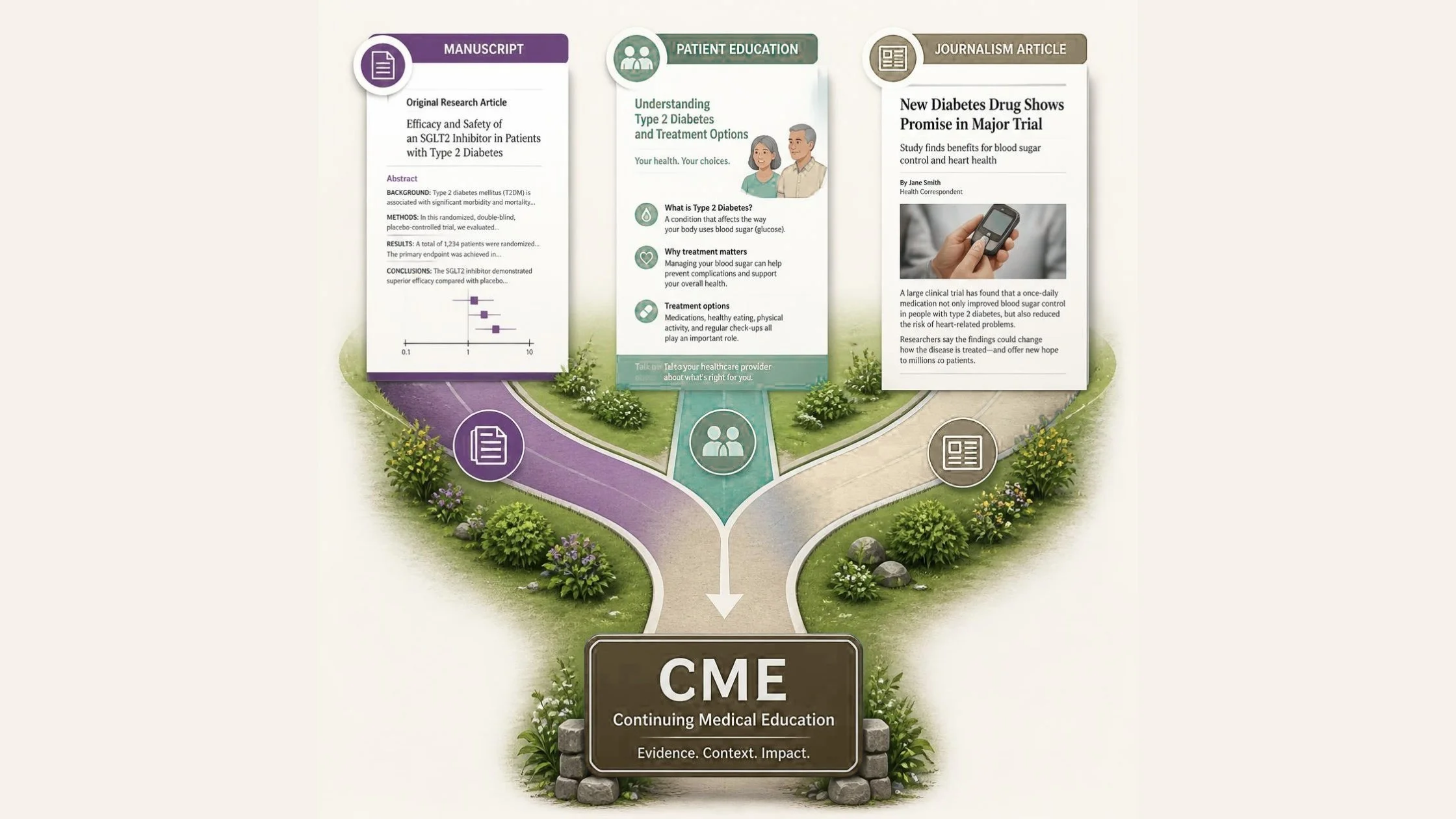
Article Summary: Adjacent medical writing can strengthen a CME writing career when chosen strategically. For newer writers, projects like patient education, medical journalism, grants, or publication support can build transferable skills and create a bridge into CME. For established writers, adjacent work can deepen authority, increase visibility, and build career resilience.
If you want to build a career in continuing medical education (CME) writing, it’s easy to assume that every project you take on should move you deeper into CME. There is value in specialization, for sure. The more you understand the CME ecosystem and are able to act as a strategic partner to your clients, the more valuable your work becomes.
However, CME as a primary niche doesn’t have to mean missing out on the value of adjacent work. Other types of medical writing — patient education, advisory board summaries, or healthcare content — can all strengthen the judgment you bring to CME.
For newer writers, these projects can help you build transferable skills and create a bridge into CME. For established CME writers, they can deepen your authority, strengthen your ability to interpret evidence in different contexts, and make your career more resilient over time.
The key is to recognize which experiences help you think more strategically as a CME writer, and how to translate those experiences into clearer positioning, stronger deliverables, and more confident client conversations.
Where are there medical writing opportunities outside of CME?
No matter where you are in your medical writing career, you’ve likely been exposed to some or all of the types of medical writing below. This is a non-exhaustive list of other medical writing opportunities outside of CME:
Manuscripts and publication support
Grant writing
Patient advisory board meetings
Patient education
Health and medical journalism
Regulatory writing
Promotional writing
Conference abstracts, posters and presentations
Thought leadership, writing for a trade publication, or other professional writing
Scientific editing
How adjacent medical writing builds you CME writing foundation
CME has a sharp learning curve. If you’re at the beginning of your career in CME, it can feel as though you’re stuck between needing experience to get clients and needing clients in order to get the experience.
That’s where adjacent writing experience can be useful, helping you build the skills CME requires.
A patient education project, for example, can strengthen your ability to translate complex clinical information into clear, practical language. An article for a trade publication can help you interpret evidence, identify what is most relevant to a professional audience, and write with authority. An editing project can sharpen your eye for structure, accuracy, and consistency. These may not be CME deliverables, but they can help you develop the skills you will use in CME: synthesizing evidence, understanding practice gaps, supporting educational design and creating content that facilitates behavior change. Adjacent work can build parts of that muscle.
This is part of what we help members practice in WriteCME Pro. Our practice labs and community events are designed to help writers understand the CME landscape, navigate freelancing, and move toward that first CME opportunity. The skills we teach are not only useful once you have a CME assignment in hand. They can also help you recognize the value in the projects you are already doing, and translate that experience into stronger positioning as you build your CME career.
WriteCME Roadmap covers the path from starting out to a successful, sustainable freelance CME career if you’re looking for a more comprehensive resource on charting your CME writing path.
How adjacent writing can build authority if you’re already an established medical writer
If you’re already an established CME writer, adjacent writing serves a different purpose. You don’t need to prove that you can write, manage a project, or be a strategic partner. At this stage, other types of writing can help you extend your authority.
That might mean contributing an article to AMWA Journal or Alliance Almanac to share what you have learned with the field or taking on a publication, advisory board summary, or patient education project that stretches a different part of your skill set.
For experienced writers, this kind of work is less about starting over and more about staying intellectually engaged. It can help you deepen your subject matter knowledge, contribute to your professional community, and build a more resilient career, one that is not dependent on a single type of project, client, or deliverable.
This is your reminder that specialization does not have to mean stasis. You can be deeply committed to CME and still allow your career to evolve.
The question is not, “Should I leave CME behind?” The better question is, “What adjacent work could strengthen the authority, curiosity, and strategic range I bring back to CME?”
Every month without a clear direction is a month your positioning falls behind. Take the WriteCME Readiness Index and find out your next best step in just two minutes.
What types of writing translate especially well to CME and what skills do they build?
While the field of medical writing is vast, some specialties offer more transferable skills than others when we consider CME. Here are the five types of medical writing that build the most transferable skills for CME writers.
Manuscripts and publication support
Manuscript and publication support can include drafting or editing manuscripts, reviewing AI-assisted drafts, helping authors respond to reviewer comments, or supporting parts of the journal submission process.
For CME writers, manuscript work gives you invaluable experience working with evidence before it ever becomes part of an educational activity.
Transferable skills include:
Data interpretation
Publication standards
Coordination between stakeholders and study authors
The International Society of Manuscript and Publications Professionals (ISMPP) is a good resource for learning more about manuscripts and publications writing.
Grant writing
Grant writing can look similar to needs assessment work because both require you to make a clear, evidence-based case for why something is needed. But CME needs assessments have their own conventions, expectations, and educational purpose.
The transferable skills from grant writing, however, are still valuable. They include:
Making a case for need or, in CME terms, a practice gap
Explaining why a problem matter
Connecting evidence to a proposed intervention
Describing measurable outcomes
Structuring a persuasive but evidence-based argument
For CME writers, grant writing experience is especially useful because needs assessments are not simply summaries of what is known. They are arguments. A strong needs assessment explains what learners are not doing, why the gap exists, what barriers may be involved, and why education is an appropriate part of the solution.
Patient education
Many CME providers have shifted toward a dual-approach to education as CME has become more patient centered. When the CME content is produced, the patient education is produced in tandem. From that perspective, being able to write good patient education is an invaluable skill not only adjacent to CME work but in it. Transferable skills from patient education include:
Transferable skills:
Plain language and/or language that keeps it simple
Audience awareness
Instructional design
Learning science
For CME writers, this skill set can be especially useful when education touches shared decision-making, adherence, counseling, diagnosis, communication, or care coordination. It helps you remember that learner behavior does not happen in a vacuum. Clinicians and patients are both learners who work with each other on a daily basis.
Medical journalism
Medical journalism can include investigative reporting, but many opportunities are closer to service journalism: articles that help a consumer or clinician understand what a new study, recommendation, treatment, or health trend means in practice.
Transferable skills:
Subject matter expert interviewing
Translating research into relevance
Writing for reader attention
For CME writers, this kind of work can sharpen your ability to identify what matters most to a specific audience.
Conference abstracts, posters and presentations
If you’re coming from a research background, you may be very familiar with conference abstracts, posters, and lectures. Refamiliarizing yourself with them in the medical writing world is a fantastic way to contribute to the medical writing community at the AMWA conference, the Alliance for Continuing Education in the Health Professions (ACEHP) Conference, or any other conference relevant to your work. Sharing your expertise in these professional spaces not only contributes to the community, but builds your authority.
Transferable skills from these experiences includes:
Learning how to present a point concisely
Data selection
Visual hierarchy
Sharing knowledge with peers
Building professional authority
Should medical writers ever write for free?
The question of writing for free often comes up when a writer is trying to break into a new area of medical writing, including CME.
I rarely advise writers to work for free. Exposure does not pay your bills, and unpaid labor should never be treated as the default entry point into professional medical writing.
That said, there are times when an unpaid opportunity may have strategic value — especially for a newer writer who needs a relevant sample or that first client.
It may be worth considering if you’re new in the field and…
You retain a public byline or usable sample
The publication or organization has real credibility
You are entering a new niche and need a relevant proof point
The scope is contained
You would be comfortable saying no to the same opportunity next time
But I would consider it a red flag when…
The organization has a budget but frames exposure as payment or asks you to write a needs assessment on spec
The scope is vague
The timeline is urgent
You cannot use the work publicly
You are doing it from fear, not strategy
Unpaid work should not be a rite of passage. If you choose to do it, it should be an intentional decision that gives you something specific you can use: a sample, a relationship, or a byline.
How do you decide whether an opportunity is worth taking?
The opportunities the medical writing world has to offer are expansive. That can be exciting, but it can also become distracting when we have our eye on an end goal.
Not every adjacent opportunity will strengthen your CME writing career. Some will build useful skills, build your authority, or deepen your understanding of a therapeutic area or type of deliverable. Others may pull you away from the goals you’re working toward.
Before you say yes to any opportunity, ask:
Will this help me build a skill I need for CME?
Will this give me a credible sample, story or proof point?
Will this connect me with people in the medical education ecosystem?
Will this strengthen my authority in a therapeutic area or writing specialty?
Will the opportunity be worth the time, even if it does not lead directly to CME work?
If the answer is no across the board, it may not be worth your time.
Discover Your Place in the Medical Writing Landscape with WriteCME Pro
As we grow in our medical writing careers, they evolve with us. CME may remain your destination, the favorite niche you return to, our become a part of your wider offerings. Wherever you land, reflecting on what your work is teaching you, what you want to build next, and how your experiences are shaping the writer you’re becoming is crucial.
That’s what we do every quarter in WriteCME Pro. Each quarter, our community pauses to look at what energized us, what challenged us, what worked, what did not, and where we want to focus next. For some members, that means building toward a first CME opportunity. For others, it means refining their positioning, deepening their strategic skills, or figuring out how to navigate difficult client conversations.
If you want structured support as you build your career as a CME writer, explore WriteCME Pro today — curriculum, Practice Labs, and a community of CME writers building businesses that work.